Photo: Tyler A. McNeil via Wikimedia Commons, CC BY-SA 4.0
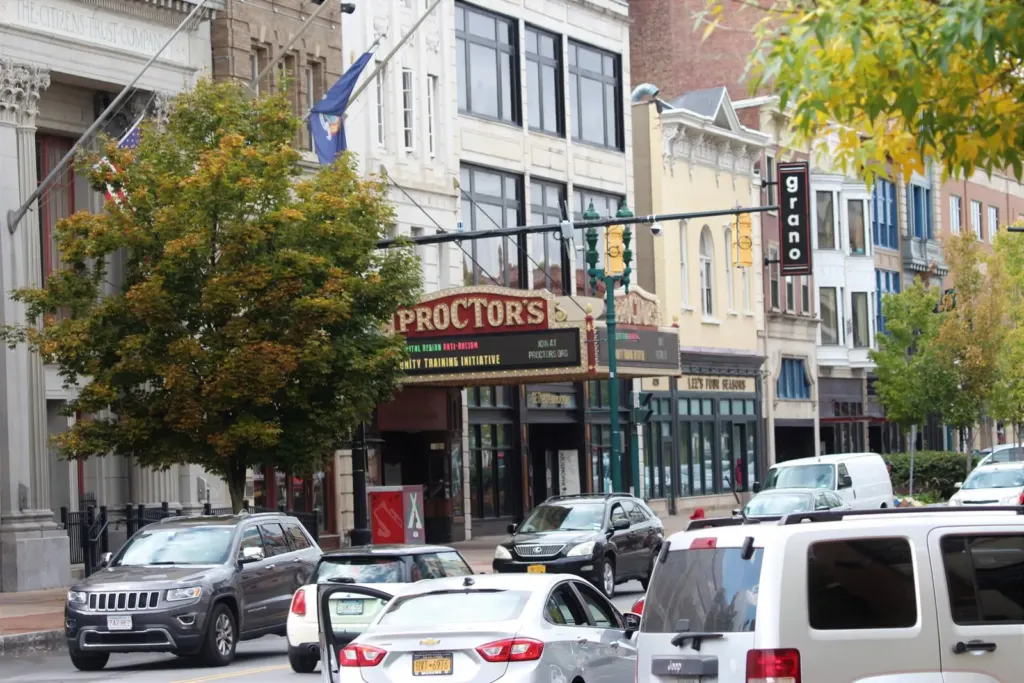
On Dec. 27, 1926, more than 7,000 people paid their way into a new vaudeville and movie palace on State Street in Schenectady. Nearly a century later, Proctors is in the middle of its 100th anniversary season, and the story of how it got here, including a stretch when it nearly disappeared, says a lot about the Capital Region itself.
The Dean of Vaudeville’s last big bet
The theater was the project of Frederick Freeman Proctor, known as the “Dean of Vaudeville,” who ran theaters across the eastern United States. According to the history published by Proctors, he leased his first Schenectady theater in 1912, alongside the Erie Canal. As General Electric and the American Locomotive Company drew workers to the city, Proctor decided Schenectady could support something far grander.
He bought land at 432 State Street and hired the renowned theater architect Thomas Lamb, whose design blended Italian Baroque style with Egyptian influences. Ground was broken on April 14, 1925. The finished building, which cost $1.5 million, featured an ornate plaster ceiling, gold accents, a giant chandelier and a ceiling mural by Danish painter August Lundberg, along with an arcade of shops connecting State Street to Smith Street.
Opening day drew those 7,000-plus paid admissions. The first ticket was bought by a 12-year-old named Michael Riccio. The bill paired the silent film “Stranded in Paris,” starring Bebe Daniels, with five vaudeville acts. A matinee cost 35 cents; an evening show, 50 cents.
A first for television
Proctors holds a distinction few theaters can claim. On May 22, 1930, GE engineer Ernst F. W. Alexanderson staged what the theater describes as the first public demonstration of television there. An orchestra in the pit followed the image of a conductor on a seven-foot screen, transmitted across the city from a GE lab. A plaque in the arcade marks the event.
The 1930s and 1940s brought big crowds for films such as “King Kong,” “The Wizard of Oz” and “Gone With the Wind,” and performers including Cab Calloway, Duke Ellington, Bob Hope and Red Skelton took the stage.
The ‘musty white elephant’
After World War II, the forces that hollowed out many downtowns hit Proctors hard: suburban growth, shopping malls and, ironically, television. By the 1970s, the theater had changed hands several times and was taken over by the city after a previous owner failed to pay taxes. Some called it a “musty white elephant,” and demolition was a real possibility.
In the summer of 1977, a group of residents and arts organizations formed the Arts Center and Theatre of Schenectady to save it. With a $25,000 feasibility study, a community fundraiser and roughly $500,000 in federal and city funds, the group made the building safe again, with volunteers cleaning the 2,700 seats by hand.
Proctors reopened on Jan. 3, 1979, with a standing-room-only show by magician Harry Blackstone Jr., whose father had played the theater in its early days. Mayor Frank Duci handed the key and deed to Katherine S. Rozendaal, president of the nonprofit, who paid the city one dollar, the agreed purchase price. “This is a significant, historic moment,” Duci said that night, according to the theater’s history.
From rescue to regional anchor
Proctors was listed on the National Register of Historic Places in 1980. A $40 million expansion that began in 2003 produced a stage house three times larger than the original, big enough for major touring Broadway productions, and added the 434-seat GE Theatre in the former Carl Company department store. In 2005, Proctors launched Marquee Power, a district energy system that heats and cools the theater and surrounding properties.
Today the nonprofit, known as Proctors Collaborative, also manages Capital Repertory Theatre in Albany and works with Universal Preservation Hall in Saratoga Springs. Its Collaborative School of the Arts trains young performers in the region.
The centennial season
Proctors announced its 2026–27 season in March, calling it the 100th anniversary season. “For 100 years, Proctors has been more than a theatre — it’s been a gathering place where our community shares stories, celebrates artistry, and creates lifelong memories,” Philip Morris, CEO of Proctors Collaborative, said at the time.
The Broadway series opened with “BOOP! The Musical” Oct. 13–18 and continues with “The Notebook” in December, “Hell’s Kitchen” at the turn of the year, “The Wiz” in February, “Mamma Mia!” in April, “Just in Time” in June and “The Phantom of the Opera” from June 23 to July 4. Singer-songwriter Sara Bareilles will headline a 100th anniversary gala on March 4, 2027, the Times Union reported this month.
The actual 100th birthday, Dec. 27, falls in the middle of that run. For a building once nearly lost, it is a reminder that saving a landmark is rarely a single act. It took a community willing to scrub seats, pay a dollar for a deed and keep buying tickets for nearly five decades since.