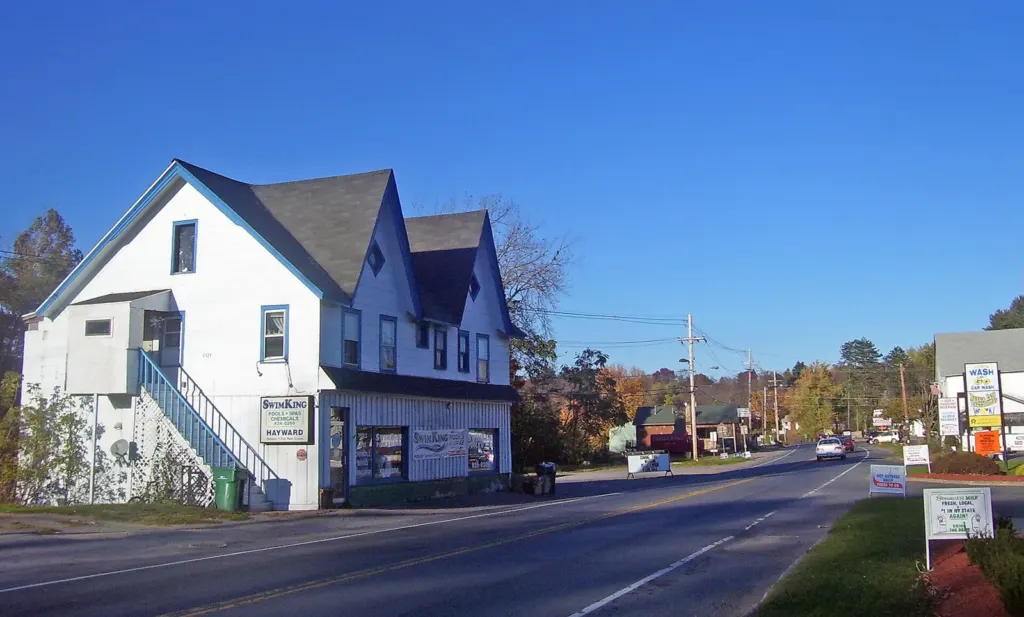
Route 209 in Kerhonkson. Photo: Daniel Case via Wikimedia Commons, CC BY-SA 3.0
For most of its agricultural history, the Hudson Valley has been known for apples, dairy and sweet corn. Rice was not on the list. A Gambian family farming in Kerhonkson has spent more than a decade proving it could be.
Ever-Growing Family Farm, on Upper Cherrytown Road in Kerhonkson, scheduled its annual rice harvest for this past Saturday, Oct. 24, and opened it to anyone who wanted to help cut and bundle the crop. It is a tradition that has drawn volunteers and curious neighbors for years. This season, according to the family, the harvest was smaller than usual.
“We still got rice, but it’s not like last year,” Malick Badjie told the Shawangunk Journal, explaining that a late frost kept many seedlings from germinating properly.
From Gambia to Ulster County
The farm is run by Nfamara Badjie, his eldest son Malick, and Nfamara’s brother Moustapha Diedhiou. The family is Jola, a West African people long associated with rice growing, and Nfamara and Moustapha were experienced rice farmers before they came to the United States. They moved to New Paltz in 2008, according to the Journal.
Rice is a warm-weather crop. In the United States it is grown mostly in places like Arkansas, Texas, Louisiana and California, not on the edge of the Catskills. Nfamara and Dawn Hoyte, then his partner, began growing it in Ulster Park in 2013. They did not initially think the crop could work in New York, Hoyte told Scenic Hudson, but a meeting with a rice farmer using Japanese methods in Vermont changed their minds. They obtained varieties from the U.S. Department of Agriculture and, in 2015, started what Scenic Hudson describes as the first experimental rice paddies in the state.
The work is physical. “Rice is intense,” Hoyte said in Scenic Hudson’s account. She described standing knee-deep in mud, transplanting seedlings by hand, and threshing by hand, which means beating the cut stalks to free the grain and then tossing it in the air to clean it, for hours.
Malick Badjie moved the operation onto paddies in Kerhonkson in 2023.
Research in a cold climate
The farm’s methods have also become the subject of formal study. With a grant from Northeast SARE, the federally funded Sustainable Agriculture Research and Education program, the farm compared the Jola practice of raising rice seedlings in a field nursery against the plug trays used in Japanese-style systems. The project’s reports found the field nursery produced hardy seedlings and gave growers more flexibility on when to transplant.
Support from groups including the NoVo Foundation and Glynwood helped the farm keep going, according to Scenic Hudson. Other Hudson Valley growers are now testing rice as well. Home Farm in Germantown is trialing 10 varieties in a project with Scenic Hudson, part of a wider interest in rice as a crop that can handle the wetter, more erratic seasons the region has been seeing.
A farm in pictures
The family’s story is also turning into an art project. Ikechukwu Sharpe, a Kerhonkson resident and MFA photography student at SUNY New Paltz, has spent nearly two years working alongside the family and documenting the farm for a project called Becoming Earth. His thesis show is planned for May 2027.
Sharpe told the Journal he first came for the harvest and stayed. “They showed me how to use the sickle. I was out there with them for hours,” he said. He said he wants the photographs to show more than labor: “If there are only photographs of them farming, our community will only look at them as farmers, but they’re also sons, fathers, soccer players.”
The Kingston Land Trust now sponsors the project and has awarded microgrants to the farm. This winter, Sharpe plans to travel to Gambia with Diedhiou.
Diedhiou described the family’s feeling about Sharpe on the first day he showed up. “We said, ‘He’s going to be with us,'” he told the Journal. “It’s because he wants to learn.”