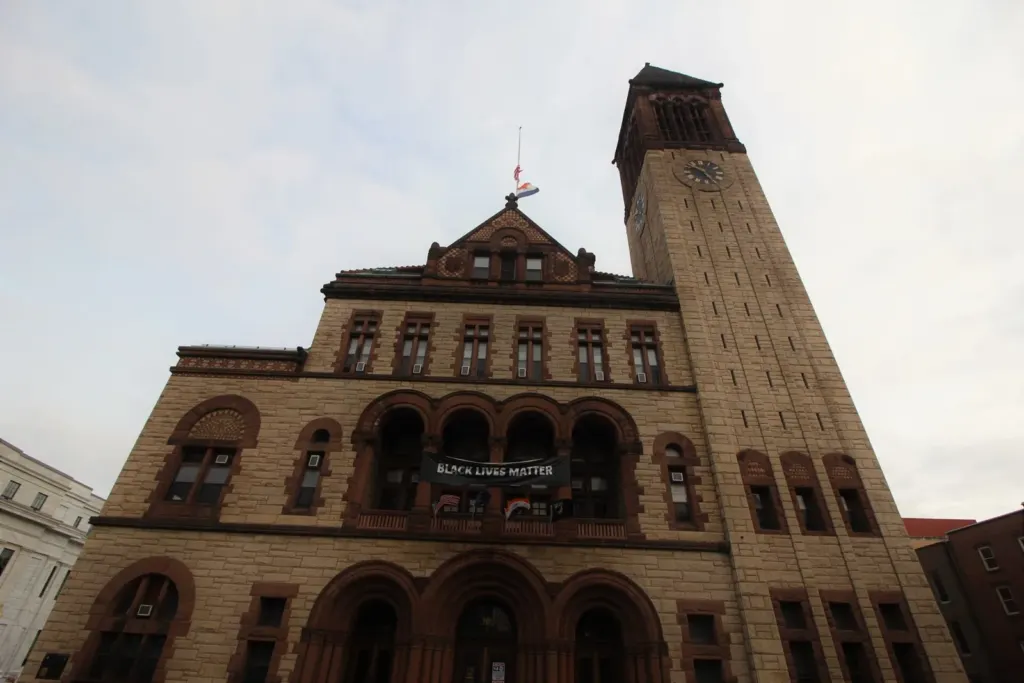
Albany City Hall on Eagle Street. Photo: Tyler A. McNeil via Wikimedia Commons, CC BY-SA 4.0
The Albany Common Council has asked the state for permission to tax the paychecks of people who work in the city but live somewhere else. Almost no one with the power to grant that permission appears willing to do it.
At its Oct. 19 meeting, the council approved a non-binding resolution asking the Legislature to authorize a commuter income tax. Reports of the tally differ slightly: nine members voted yes, and the rest either voted no or declined to take a position. The resolution, sponsored by Councilmember Derek Johnson, does not set a rate or say whether hybrid workers would count as commuters. The city could not impose the tax on its own. It would need a change in state law passed by the Legislature and signed by the governor.
The math behind the idea
Albany’s interest in the idea comes from its budget. The city faces a projected $26 million operating deficit for 2026, and the 2027 budget proposed by Mayor Dorcey Applyrs includes a 15 percent property tax levy increase. The council has until Nov. 30 to adopt a budget.
A memo from Chief City Auditor Sam Fein put numbers to the commuter question. More than 86 percent of the city’s primary workforce, about 107,281 people, lives outside the city, according to the memo as reported by Spotlight News. Fein estimated a commuter tax could raise $15 million to $28 million a year, depending on the rate.
Supporters argue that commuters use city roads, sewers and emergency services during the workday without paying the property taxes that fund them. “A bailout is not going to fix Albany because a bailout is a one-time payment,” Johnson said before the vote, according to WAMC. “We need something that’s going to be reoccurring.”
The idea is not new. In 2005, the council passed a similar resolution calling for a 0.33 percent tax on commuters. It went nowhere.
The mayor says no
Applyrs came out against the proposal hours before the vote, while making a broader point about how the city is funded.
“While a commuter tax is not a viable solution to our budget challenges, the discussion raises important questions that deserve our attention,” she said in a statement. “The Capital City cannot thrive without shared responsibility and financial support from those who rely on our resources and services.”
Some council members who did not support the resolution made a similar argument. Councilmember Ginnie Farrell, who voted “present,” said New York’s tax structure “works against cities” that rely on property taxes while providing regional services.
The delegation says no
The more decisive opposition came from the two state lawmakers who represent Albany. State Sen. Patricia Fahy and Assemblymember Gabriella Romero both rejected the proposal.
“It’s the wrong approach,” Fahy told Spotlight News. “It sends the wrong message at the wrong time.” She pointed to recent state investment in the city, including grants for 300 housing units and a state-funded $400 million revitalization plan, and said Albany needs “more feet on the street, more businesses, more apartment dwellers and new investors.”
On the bill’s chances, she was blunt. “Gabriella and I already said a strong no, so it is almost unheard of for such legislation to go forward,” Fahy said.
The suburbs say no
Neighboring towns, whose residents would pay the tax, have been the loudest critics.
In an Oct. 19 letter to the mayor and council, Bethlehem Supervisor David VanLuven and the Bethlehem Town Board urged rejection. The town said about 6,000 of its residents work in Albany and spend money there on food and drinks during the workday. “The city shouldn’t tax people for the privilege of showing up for work. That’s wrong,” Bethlehem board member David DeCancio said in a statement.
Menands Mayor Brian Marsh called it “a race to the bottom” and said Menands would court Albany businesses to relocate if the tax ever passed. Colonie Supervisor Peter Crummey said he does not consider it a viable option.
For now, the resolution is more statement than policy. The budget problem it was meant to address remains, and the council’s Nov. 30 deadline is five weeks away.