Photo: Tyler A. McNeil via Wikimedia Commons, CC BY-SA 4.0
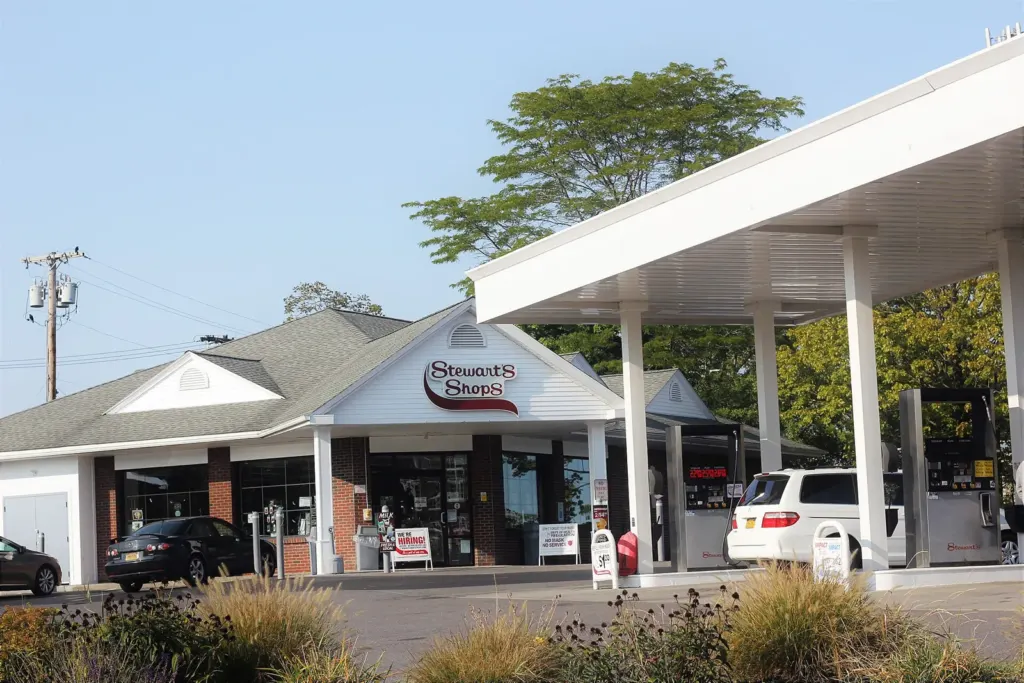
For a lot of people in the Capital Region, the nearest Stewart’s Shop is less a convenience store than a fixture of daily life: coffee on the way to work, a gallon of milk on the way home, a cone of ice cream on a summer night. Behind that familiarity is one of the region’s most distinctive companies, a Saratoga County business that has stayed family-controlled for 80 years, is substantially owned by its own employees and makes much of what it sells.
From a Ballston Spa dairy to 400 shops
The company traces its start to 1945, when the Dake brothers bought a small dairy and ice cream business in Ballston Spa. That shop became the first Stewart’s. Today the chain operates more than 400 shops across upstate New York, Vermont and western New Hampshire, and in its review of 2025 the company said its workforce had grown to more than 5,500 people.
The Dake family still runs the business. Bill Dake, the chairman, is in his 90s and, according to the company, still comes into the office every day and stays involved in strategy and operations. His son, Gary Dake, is the third generation of the family to serve as chief executive and has worked at the company for more than 40 years.
In 2025 the company reached a milestone of a different kind. Chad Kiesow, who had been chief operating officer, was promoted to president, the first time in Stewart’s history that the president has not been a member of the Dake family.
Owned in part by the people behind the counter
What sets Stewart’s apart from most convenience chains is its ownership. The Dake family owns roughly 60% of the business and employees own about 40% through an Employee Stock Ownership Plan, which the company also calls Profit Sharing. That is why Stewart’s refers to its workers as “partners.”
Unlike a typical 401(k) with a company match, the ESOP is entirely company funded. In January 2026, Stewart’s announced it would contribute an amount equal to 20% of eligible partners’ annual salary into the plan, above the 17% average of the previous five years. The company said the plan has about 4,300 participants, including roughly 1,000 retirees and 3,300 active employees eligible for the contribution.
“Our partners in the shops, at the plant and in the office are the very people who make us different,” Kiesow said in the company’s announcement. “They are the reason we are successful.”
In 2025 the Times Union named Stewart’s a Top Workplace for the eighth time.
Making the milk and ice cream itself
The other pillar of the business is vertical integration. Stewart’s says it distributes more than 75% of the products it sells, and it makes its own milk and ice cream at its dairy in Greenfield Center, just outside Saratoga Springs, where the distribution and manufacturing plant covers more than five acres of a 50-acre parcel.
Raw milk comes from 19 local dairy farms and is pasteurized and packaged within 24 to 48 hours of leaving the farm, according to the company. Its milk, ice cream, cream and eggs carry the New York State Grown & Certified seal, and the company picks up more than 48,000 eggs a day from Thomas’ Poultry Farm in Schuylerville, about 15 miles from the plant.
To keep up with growth, Stewart’s is in the middle of a multiyear, $30 million expansion of the Greenfield plant and its commercial kitchen.
Growing into new markets
The biggest recent jump in the chain’s footprint came in December 2024, when Stewart’s completed its purchase of the assets of Jolley Associates, a family-founded convenience chain that was a market leader in Vermont, along with two affiliated businesses, S.B. Collins and the St. Albans heating oil company Clarence Brown. The deal added 45 stores, 38 in Vermont, five in New York and two in New Hampshire, and brought Stewart’s into New Hampshire for the first time. Terms were not disclosed, and the Jolley stores are being rebranded over time, several of them gaining Stewart’s ice cream counters.
Expansion has continued this year. In May the company said it is investing $55 million in 2026 to build, renovate and rebuild shops, including new locations in Sidney, Alexandria Bay and Cohoes and rebuilds in Saratoga Springs, Wilton, Dolgeville, Norwich, St. Johnsville and Watertown. At least 15 older, smaller shops are being remodeled to expand food and beverage offerings.
“Stewart’s one-stop-shop model of serving as a coffee shop, a restaurant, an ice cream shop and a gas station has helped the company play an important role in neighborhoods throughout New York and Vermont,” Kiesow said in the announcement.
A long habit of giving
The company’s community giving is woven into the same local identity. Its annual Holiday Match, in which customers donate at the register between Thanksgiving and Christmas and Stewart’s matches every dollar, marked its 40th year in 2025. The campaign raised more than $1.8 million for children’s charities in New York, Vermont and New Hampshire, with customers contributing more than $900,000. Since it began in 1986, the program has raised more than $40 million, according to the company,.
Together with the Dake family’s foundations, Stewart’s says it donates about $12 million to local nonprofit organizations.
Why it matters for the region
Stewart’s is a reminder that some of the Capital Region’s most recognizable brands are homegrown. Its mix of family control, employee ownership and in-house production is unusual among convenience chains, and it keeps decision-making, manufacturing and a sizable payroll anchored in Saratoga County.
For entrepreneurs, the company’s path offers a few lessons: own the products customers come back for, share the upside with the people who serve them, and grow at a pace that does not outrun the supply chain. Eighty years after a dairy purchase in Ballston Spa, that formula has carried Stewart’s to more than 400 shops, and it is still expanding.