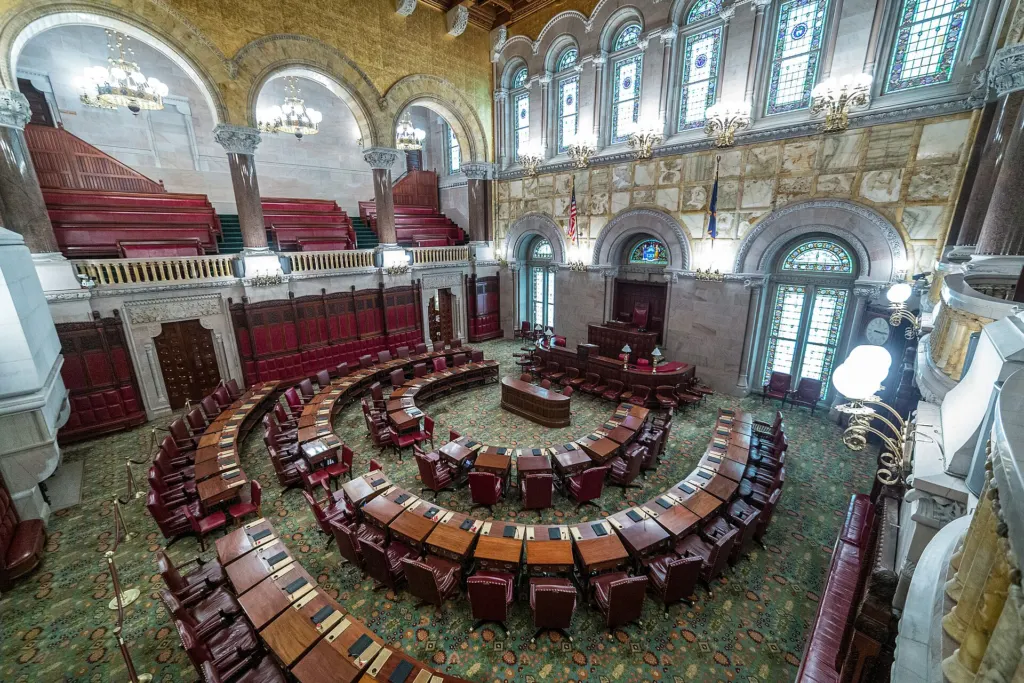
Photo: Kenneth C. Zirkel / Wikimedia Commons, CC BY-SA 4.0
Every address in New York is represented in Albany by one state senator and one member of the Assembly. The Senate has 63 members and the Assembly 150, all elected to two-year terms in even-numbered years. Knowing who represents you, and how to reach them, is the simplest way to have a say in what happens at the Capitol.
Finding your legislators
The quickest route is the lookup tool on each chamber’s website. The Senate’s “Find My Senator” page at nysenate.gov and the Assembly’s member search at nyassembly.gov both accept a street address. Because district lines do not follow town or county borders neatly, use your full address rather than your town name. The New York State Board of Elections and your county board of elections can also confirm your districts.
District office or Albany office?
Each legislator has an office in the Legislative Office Building in Albany and at least one district office at home. For help with a state agency, such as a delayed tax refund, a DMV problem or an unemployment claim, the district office is usually the right first call. Staff there handle constituent casework every day. For views on legislation, both offices take messages, and email or a letter on paper are counted.
A short, specific message works best: say that you are a constituent, give your address, name the bill number if there is one, and say what you want the legislator to do.
Reading a bill
Bills in New York carry a chamber prefix and a number: S for Senate and A for Assembly. Most proposals have a “same as” bill in the other house, and both must pass in identical form. On nysenate.gov, each bill page shows the sponsor, co-sponsors, committee, every amendment (marked with a letter, such as S1234A) and the full text. The sponsor’s memo, which explains the purpose of the bill and its history, is often the most readable part.
The Assembly’s bill search at nyassembly.gov shows the same information plus committee and floor votes. On either site, you can see where a bill stands: introduced, in committee, reported, on the floor calendar, passed, delivered to the governor, signed or vetoed.
After both houses pass a bill
A bill that passes both houses is not delivered to the governor right away. The Legislature sends bills in batches, often for months after the session ends in June. Once a bill is delivered, the governor has 10 days, excluding Sundays, to act while the Legislature is in session, or 30 days after delivery once the Legislature has adjourned. Many bills are signed with “chapter amendments” negotiated in advance.
Testifying and watching
Committees hold public hearings on budget subjects in winter and on specific issues throughout the year. Hearing notices and instructions for submitting written testimony are posted on both chamber websites, and sessions and hearings are streamed live and archived. Floor sessions are open to the public from the galleries of the Senate and Assembly chambers in the Capitol.
Local government is different
Your county legislators, city council members and town board members are separate officials with their own offices. Albany County, Rensselaer County, Schenectady County and Saratoga County each post legislator lookup tools and meeting agendas on their own websites.