Photo: Charles J. Sharp / Wikimedia Commons, CC BY-SA 4.0
Fall is orb-weaver season in the Hudson Valley. The large, wheel-shaped webs strung across porches, gardens and field edges in September and October belong to spiders that have been growing all summer. Spiders have enemies, though, and some of the strangest are tiny parasitic wasps that do not just eat their hosts but redirect their behavior.
The cocoon web
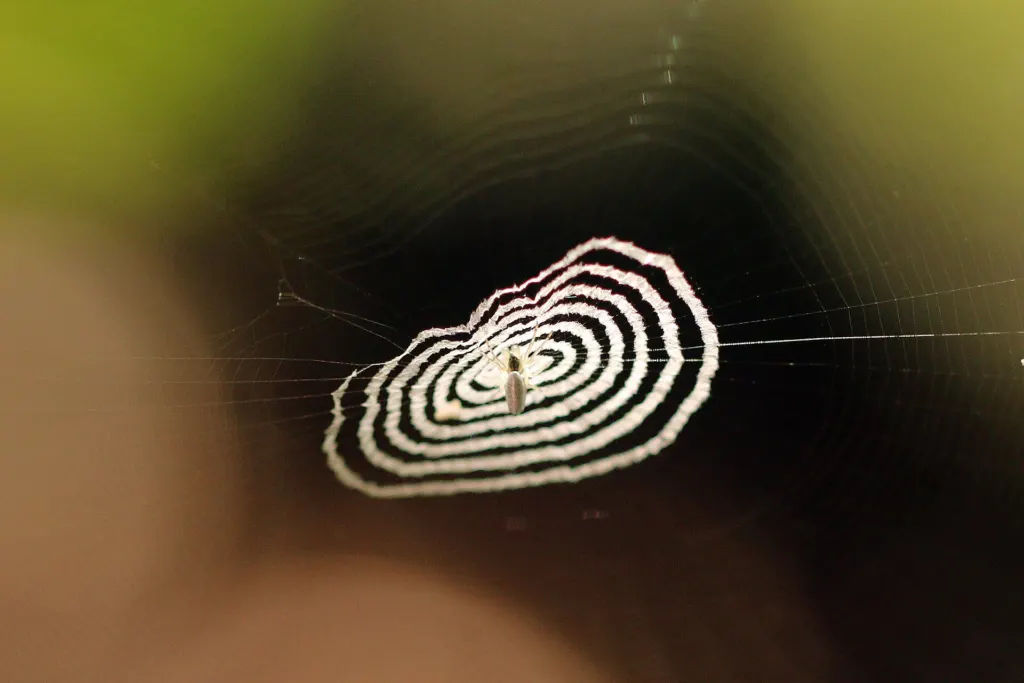
The best-known example was described by the biologist William Eberhard in Costa Rica. A female wasp, Hymenoepimecis argyraphaga, stings an orb-weaving spider, Leucauge argyra, and lays an egg on its abdomen. The spider recovers and goes on building webs while the larva feeds on it from the outside.
On the night the larva is ready to kill its host, the spider abandons its usual design and builds something entirely different: a simple, reinforced structure of a few strong lines repeated many times. The larva then kills the spider, spins its cocoon and hangs from the new structure, which is far better at withstanding rain and wind than an ordinary orb web. Eberhard’s work, published in the journal Nature in 2000, showed that the change was caused by the larva, apparently through a chemical it injects.
More examples
Since then, researchers have documented similar manipulation in other wasp and spider pairs. A study in Japan found that a wasp larva causes its host spider to build a web that resembles the special resting web the spider normally builds before molting, suggesting the wasp hijacks a behavior the spider already has rather than inventing a new one. Related wasps in the genus Zatypota manipulate cobweb spiders in comparable ways.
Why it matters
Behavior-altering parasites are one of biology’s most vivid demonstrations of how genes in one organism can shape the behavior of another. Scientists are interested in the chemistry involved, which may reveal how spider web-building is controlled in the first place.
Spiders in your own yard
New York’s common orb-weavers include the black-and-yellow garden spider, Argiope aurantia, and several species of Araneus, including the cross orbweaver. They are harmless to people and eat large numbers of insects. Most die with the first hard frosts, leaving egg sacs that hatch in spring. If you find a large web near a door, the Cornell Cooperative Extension office in your county can help identify the spider.