Photo: H. Zell / Wikimedia Commons, CC BY-SA 3.0
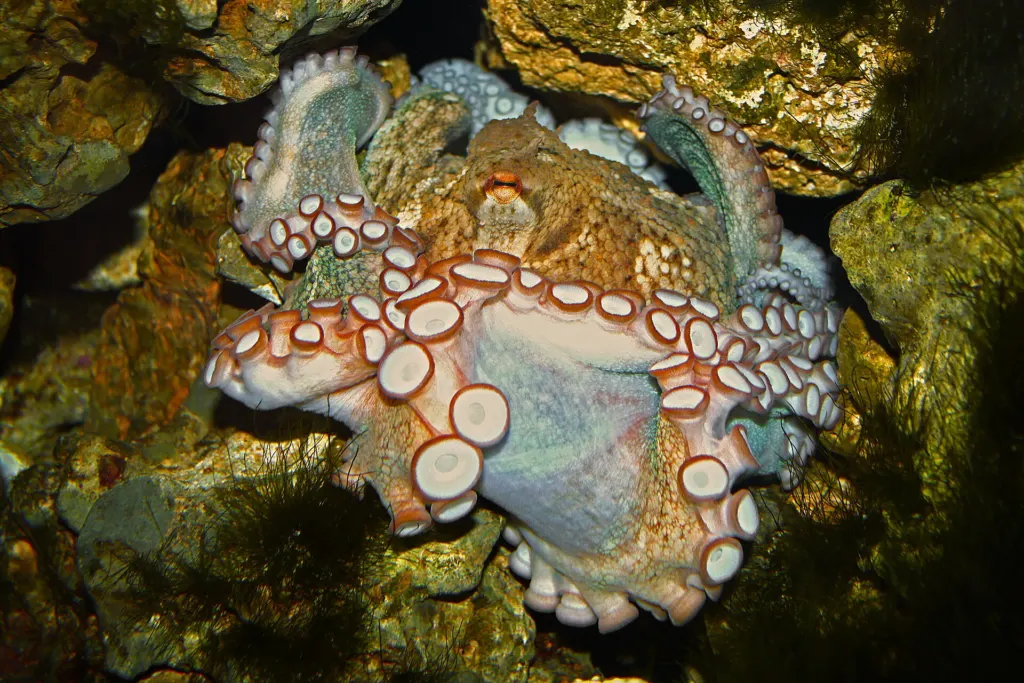
Watch an octopus crawl across the sea floor and it looks improvised: arms reach, push and curl in no obvious order, and the body slides along in a direction that may have nothing to do with where its eyes are pointing. Scientists who have studied that movement say it reflects a nervous system organized very differently from ours.
A brain spread through the arms
The common octopus has roughly 500 million neurons, a number comparable to some mammals. About two-thirds of them are in the arms rather than the central brain. Each arm can sense, taste and grasp on its own, and severed arms continue to respond to touch. That raised a long-standing question: how does the animal coordinate eight such independent limbs?
What the filming showed
Researchers at the Hebrew University of Jerusalem filmed octopuses crawling and analyzed the movement of each arm. Their study, published in Current Biology in 2015, found that octopuses crawl by pushing with their arms, shortening and elongating them rather than pulling the body forward, and that they do not use a fixed rhythmic pattern of the kind seen in walking animals.
The octopus also chooses which arms push, according to the direction it wants to go, and it can move in any direction relative to its body. It does not need to turn to face where it is heading. The authors suggested that this arrangement lets the central brain choose a direction while the arms handle the details locally, a strategy that simplifies control of a body with nearly unlimited ways to move.
Walking on two arms
Some species take it further. Researchers at the University of California, Berkeley, documented octopuses that tuck six arms around their bodies and “walk” on the remaining two, rolling them along the sand like tank treads, possibly to look like a rolling clump of algae or coconut shell while escaping predators.
Why engineers care
Soft robotics researchers study octopus arms because they combine flexibility with strength and precise control without joints. Engineers have built grippers and flexible arms inspired by octopus suckers and muscle structure, with possible uses in surgery, underwater work and handling delicate objects.
For anyone who wants to see the real thing, public aquariums along the East Coast keep octopuses, and many offer feeding demonstrations that show how the arms explore and grasp.