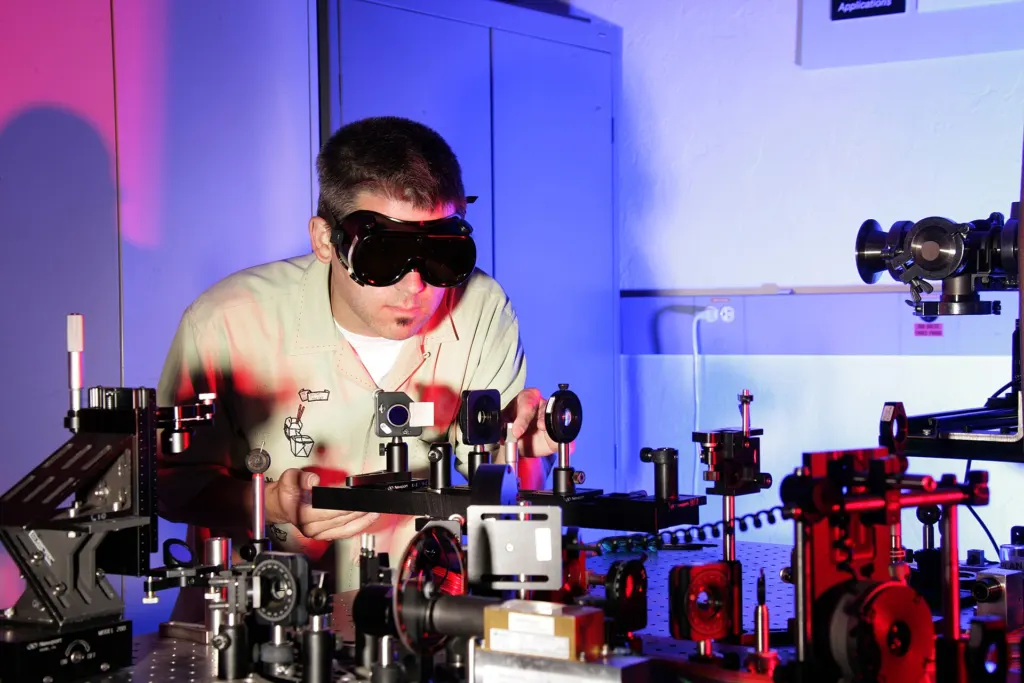
Photo: Idaho National Laboratory / Wikimedia Commons, CC BY 2.0
Graphene, a sheet of carbon one atom thick, has been studied intensely since researchers at the University of Manchester isolated it in 2004, work that earned the 2010 Nobel Prize in Physics. Among its many unusual properties is the way it interacts with light, which has made it a candidate for producing ultrashort laser pulses.
What ultrafast lasers do
Ultrafast lasers emit pulses lasting picoseconds or femtoseconds, trillionths to quadrillionths of a second. Such short pulses can freeze the motion of molecules, cut materials with little heat damage and image living tissue in depth. They are used in spectroscopy, eye surgery, micromachining and nonlinear microscopy.
The most common way to make them is mode-locking, which uses a component called a saturable absorber. It absorbs weak light but becomes transparent under intense light, so it favors short, intense bursts over continuous emission.
Where graphene comes in
Researchers at the Cambridge Graphene Centre at the University of Cambridge, along with groups elsewhere, showed that graphene works as a saturable absorber over an unusually wide range of wavelengths. Because it absorbs light across the spectrum, a single graphene device can mode-lock lasers in the visible, near-infrared and mid-infrared. That flexibility, together with the potential for cheap, simple fabrication, is what makes it attractive. The researchers described possible uses in spectroscopy, which identifies chemicals from the light they absorb, and in biomedical imaging and diagnostics.
From lab to market
Turning graphene into commercial products has taken longer than early enthusiasm suggested. Producing large sheets of uniform quality and integrating them with existing manufacturing processes are ongoing challenges. Europe’s Graphene Flagship research program has funded efforts to move the material into photonics, electronics and sensors.
The Capital Region connection
Two-dimensional materials are an active area of research in the region. Rensselaer Polytechnic Institute in Troy has long-running nanomaterials and photonics programs, and the University at Albany’s College of Nanotechnology, Science, and Engineering conducts research on advanced materials. The Albany NanoTech Complex, operated by NY CREATES, gives companies and researchers access to industrial-scale semiconductor equipment, which is the kind of infrastructure needed to test whether new materials can be manufactured reliably.
For a region whose economy increasingly depends on semiconductors and photonics, those research pipelines are as important as any single breakthrough.