Photo: Agiorgio / Wikimedia Commons, CC BY-SA 4.0
Quantum computers use quantum bits, or qubits, which can represent combinations of 0 and 1 at the same time and become entangled with one another. In principle, that allows certain problems to be solved far faster than any classical computer can manage: simulating molecules for chemistry and drug design, optimizing complex systems and breaking some forms of encryption.
The speed and error problem
The difficulty is that qubits are fragile. Heat, vibration and stray electromagnetic signals cause errors within tiny fractions of a second. A useful quantum computer must perform many operations before its qubits lose their information, which means either making each operation faster, making qubits more stable, or both.
Researchers around the world are attacking the problem from several directions: faster and more precise control pulses for superconducting qubits, new qubit designs that are inherently less sensitive to noise, and better materials and fabrication to remove defects that cause errors. The long-term answer is quantum error correction, which spreads the information of one “logical” qubit across many physical qubits so errors can be detected and fixed during a calculation.
The Poughkeepsie connection
IBM has deep roots in the mid-Hudson Valley. Its Poughkeepsie site was for decades the home of the company’s mainframe computers, and it remains a major engineering and manufacturing center. In 2019, IBM opened a quantum computation center in Poughkeepsie to house the quantum systems it makes available to companies, universities and researchers through the cloud.
In 2025, IBM laid out a plan to build a large-scale, fault-tolerant quantum computer, which it calls Starling, at its Poughkeepsie quantum data center by the end of the decade. The company has published a roadmap of intermediate processors and the error-correction methods it intends to use.
Why it matters for the region
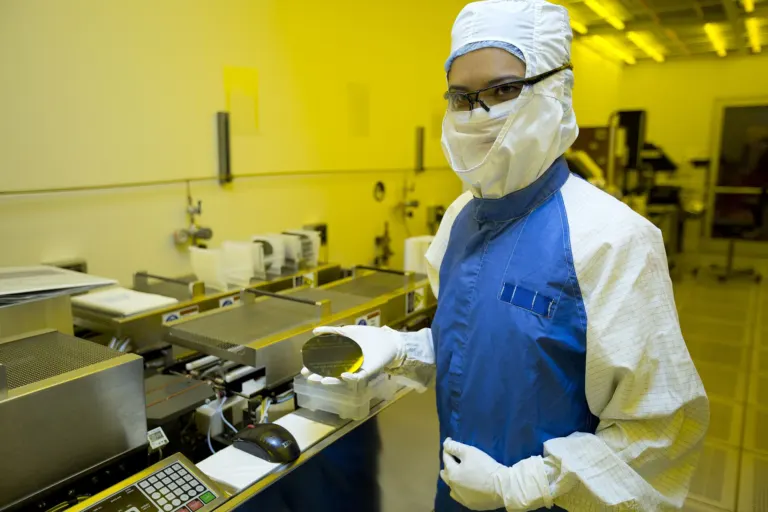
- Jobs and skills: quantum hardware requires engineers in cryogenics, microwave electronics, software and fabrication, overlapping with the semiconductor work at Albany NanoTech and GlobalFoundries in Malta.
- Research ties: Rensselaer Polytechnic Institute installed an IBM Quantum System One on its Troy campus in 2024, among the first on a U.S. university campus.
- State strategy: New York’s economic development agencies have made semiconductors, advanced computing and quantum technologies a priority for the corridor from New York City through the Hudson Valley to the Capital Region and beyond.
Practical quantum computing is still years away for most applications. But the parts that make it possible, from chips to cooling systems to software, are increasingly being built nearby.