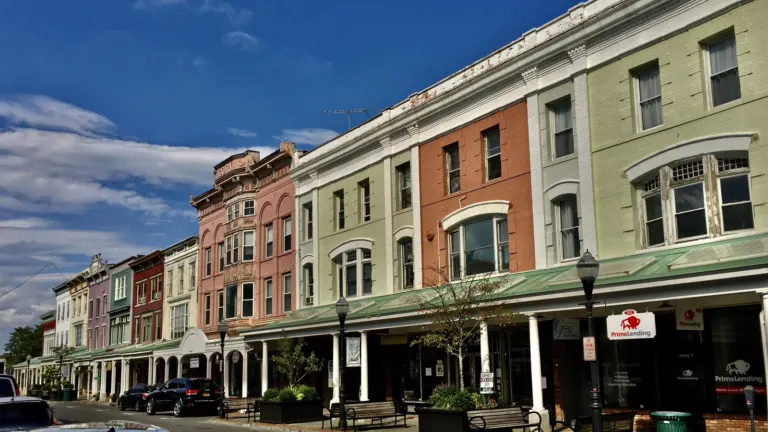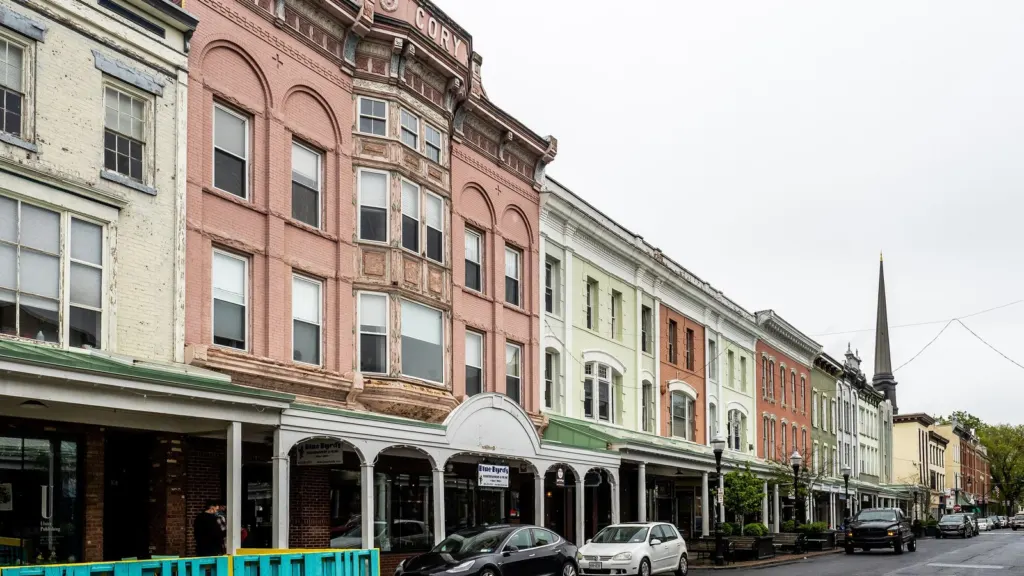
Storefronts in uptown Kingston's Stockade District. Photo: ajay_suresh / Wikimedia Commons, CC BY 2.0
Kingston’s form-based zoning code has been on the books for a little more than three years, and the city says the Planning Board has approved more than 30 major site plans under it, authorizing more than 500 new housing units. Now a city working group wants residents to say whether the code is doing what it promised.
The Zoning Code Working Group, which has been reviewing the code with city staff, opened a public survey on Nov. 17. It takes about five minutes and stays open through Dec. 31, according to the city’s announcement.
The answers will feed what the city calls its three-year evaluation of the code. The questions cover how people experience new development and neighborhood change, and how the code’s goals are being carried out.
What the 2023 code changed
The city adopted the code on Aug. 2, 2023. A form-based code regulates the form of buildings and how they meet the street as much as what goes on inside them. Every parcel is assigned to one of five “transects,” running from the least developed (T1) to the most developed (T5), or to a special district. Overlays for historic districts and extra building height sit on top of that.
The city’s stated aim was to make it easier to build in Kingston while protecting the character of places like the Stockade District uptown. The code also created an expedited minor site plan review for qualifying projects. Larger projects still go to the Planning Board as major site plans.
The code won Smart Growth America’s 2024 Form-Based Code Award and a 2024 Charter Award from the Congress for the New Urbanism. It came with a housing target: approve 1,000 new homes between 2024 and 2029, a figure the city tracks on a public dashboard.
Reading the numbers
The 500-plus units the city cites were authorized as conditions of site plan approvals since 2023, so they are approvals, not finished apartments. They also start counting a few months before the 2024-2029 window for the 1,000-home goal. Still, if most of those approvals fall inside the goal period, Kingston is roughly halfway to its target with about three years left.
Approval is not construction, and the release does not say how many of the approved units have been built or are under way. The survey asks residents to describe what they are seeing on their own blocks, which gives the working group something the approval count can’t.
“The working group looks at how the zoning code is affecting housing development, walkability, and small business development, among other aspects of municipal life,” Mayor Steven Noble said in the release. Norah Maki, a Kingston resident who sits on the working group, said in the same release that “it’s important to hear from city residents about their experience with new development projects and whether they feel these aspects of city life are improving.”
Other street-level work this winter
The survey lands as the city takes on several walkability projects. Construction on new bluestone sidewalks, curbs and a ramp at Albany Avenue and Maiden Lane around Academy Green Park was set to start this week and take about three weeks, at a cost of $943,174.30 paid from the city’s federal Community Development Block Grant money, the city said Nov. 20. The city’s parking survey runs until Dec. 18, and uptown, new signboards went up on 22 storefronts under the Pike Plan canopy this month.
Residents interested in how the city’s rules get rewritten more broadly can also weigh in at the charter commission’s Dec. 9 forum. The zoning survey closes Dec. 31. For more from Ulster and Dutchess counties, see our Hudson Valley section.
Add Observer Chronicle as a preferred source on Google (opens in a new tab)