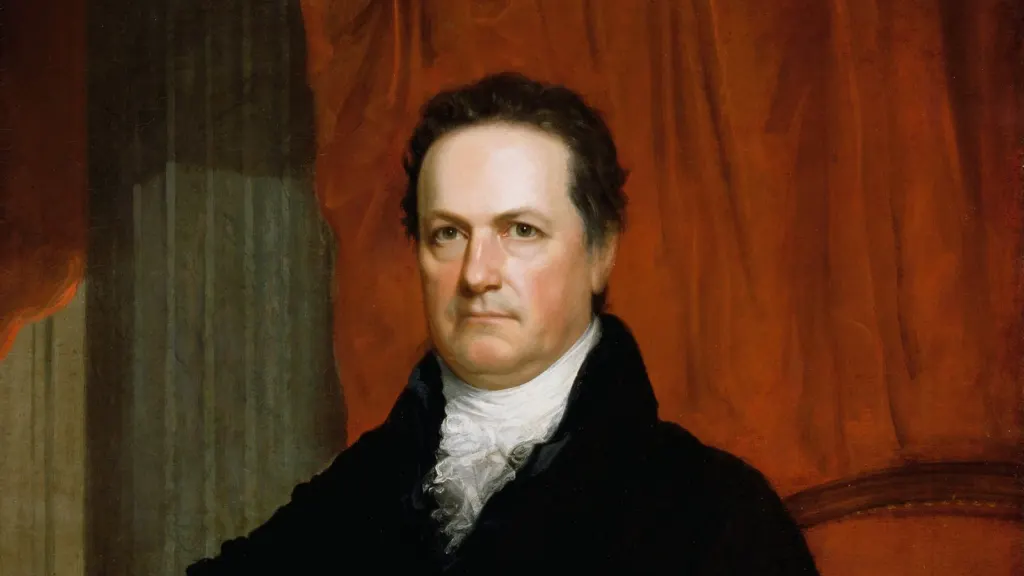
DeWitt Clinton, painted by John Wesley Jarvis around 1816. Photo: John Wesley Jarvis / Wikimedia Commons, public domain
When the first boats of the Erie Canal reached Albany in the fall of 1825, they turned a river town at the bottom of the Mohawk Valley into the eastern gate of a water highway to the Great Lakes. The man most responsible was DeWitt Clinton, a governor his opponents had mocked for years over what they called “Clinton’s Ditch.”
Clinton’s portrait still hangs in the Hall of Governors at the State Capitol, where the state’s biography calls him the “Father of the Erie Canal.” He was the sixth governor of New York, serving from 1817 to 1822 and again from 1825 until he died in office in Albany on Feb. 11, 1828.
From secretary to mayor
Clinton was born in 1769, probably in New Windsor in Orange County, into a family already powerful in New York politics. His father, James Clinton, was a surveyor and Revolutionary War general. His uncle, George Clinton, was the state’s first governor, and in 1787 he hired his nephew, fresh out of Columbia College, as his private secretary.
The younger Clinton moved through nearly every office the state had to offer. According to The Encyclopedia of New York State, whose entry the Capitol reproduces, he won an Assembly seat in 1797, moved to the state Senate the next year and was elected to the U.S. Senate in 1802. He resigned the following year to become mayor of New York City, a job then filled by appointment, and held it for most of the next 12 years. He was lieutenant governor from 1811 to 1813, and in 1812 he ran for president against James Madison, losing 128 electoral votes to 89.
He also had a temper. In 1802 he fought a duel with John Swartwout, an ally of Aaron Burr, and wounded him twice in the leg before declining to fire again.
The canal fight
The idea of a canal across New York was not Clinton’s alone, but he made it his. He helped create the state commissions of 1810 and 1811 that explored routes west, and after a Dec. 30, 1815, meeting in New York City he wrote the memorial to the Legislature that argued for an inland canal from the Hudson near Albany all the way to Lake Erie. The state, he wrote, was “both Atlantic and western.”
The Legislature authorized surveys in 1816 and construction in 1817, the year Clinton was elected governor. Digging began near Rome on July 4, 1817. Critics in New York City and eastern counties worried the project would drain money and power west, and the name “Clinton’s Ditch” was meant as an insult.
Politics nearly cost him the canal’s triumph. Martin Van Buren’s Bucktail faction, later known as the Albany Regency, won control of the Legislature, and Clinton declined to seek another term in 1822. In 1824 the Bucktails threw him off the Canal Commission altogether. The move backfired. Voters returned Clinton to the governorship that fall by a margin of almost 9% of the vote.
So it was Governor Clinton who rode the packet boat Seneca Chief from Buffalo to New York in the fall of 1825 and, on Nov. 4, poured a keg of Lake Erie water into New York Harbor in what became known as the Wedding of the Waters.
What the canal did for Albany
The finished canal ran 363 miles from Buffalo to the Hudson, and its eastern end sat at Albany. Grain, lumber and settlers moved east and west through the Capital Region, and Albany’s basin and waterfront filled with boats. The New York State Museum, a few blocks from the Capitol, devotes a major exhibition to the canal’s history and its effect on the state.
Clinton did not live long to see it. Overweight and in poor health, he died suddenly of heart failure in February 1828, less than three years after the canal opened. He was later buried at Green-Wood Cemetery in Brooklyn.
He pushed for more than canals. The state biography describes him as an advocate for educational, social and economic reform. As mayor he backed the Free School Society and the New-York Historical Society and pressed to end the religious test oath that kept Catholics out of office. As governor he called for professional training for teachers and a road across the Southern Tier.
Clinton shares an era with other figures in our Local Leaders series, including his rival Martin Van Buren and the Albany Academy teacher Joseph Henry. For a later chapter of Albany politics, see our profile of Erastus Corning 2nd.
The Capitol offers free public tours on weekdays, and Clinton’s portrait is part of the Hall of Governors collection described on the Empire State Plaza website.
Add Observer Chronicle as a preferred source on Google (opens in a new tab)