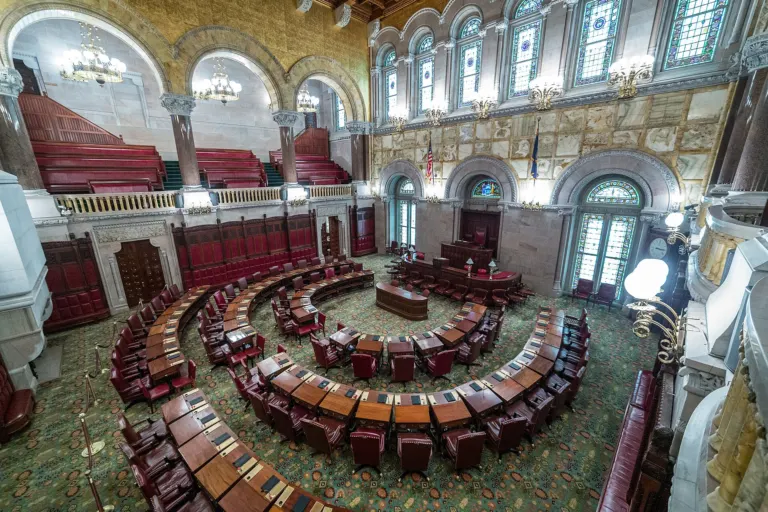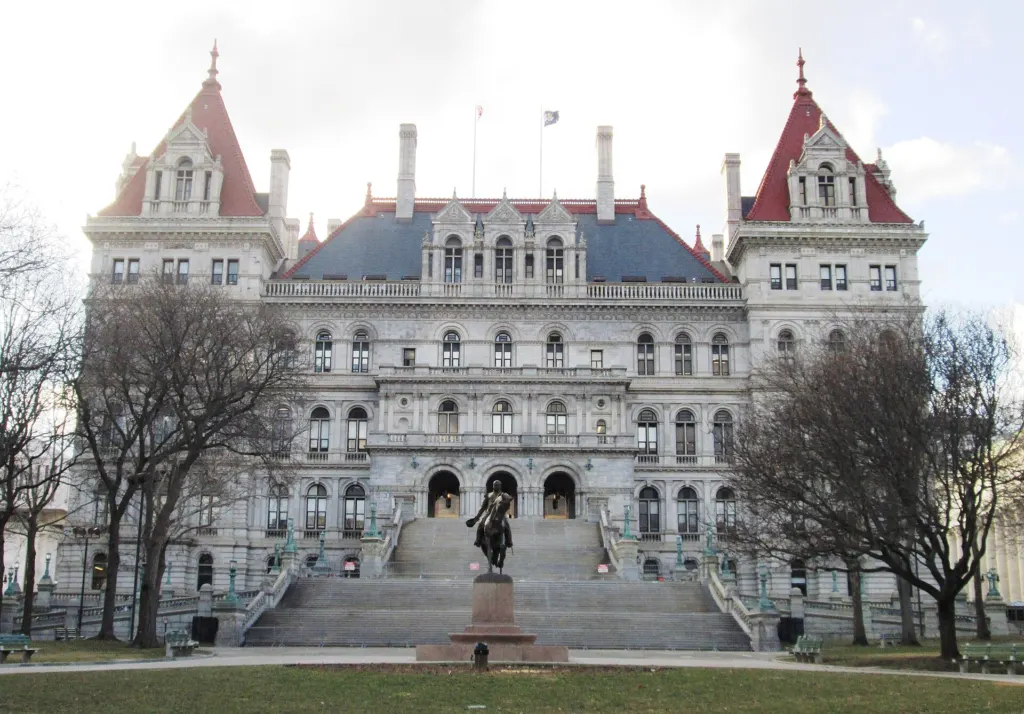
Photo: Beyond My Ken / Wikimedia Commons, CC BY-SA 4.0
New York’s state budget is the single most consequential piece of legislation passed at the Capitol each year. It sets school aid for every district in the Capital Region, funds the SUNY campuses in Albany and New Paltz, pays for Medicaid and transit, and often carries major policy changes that have nothing to do with spending. Understanding the calendar makes the headlines from Albany much easier to follow.
The fiscal year starts April 1
The state’s fiscal year runs from April 1 to March 31. The State Constitution gives the governor the lead role: Article VII requires the governor to submit a budget and the bills needed to carry it out. The Legislature can strike or reduce items in the governor’s appropriation bills and can add items of its own, but those additions must be stated separately and are subject to the governor’s line-item veto.
January: the executive budget
The governor typically outlines priorities in the State of the State address in early January and then releases the Executive Budget, usually later that month. The release includes the appropriation bills, the “Article VII” language bills that change state law, and a briefing book and financial plan prepared by the Division of the Budget. Within 30 days, the governor may submit amendments, often called the 30-day amendments.
February: hearings
The Senate Finance Committee and the Assembly Ways and Means Committee hold joint legislative budget hearings on each major area: health, education, transportation, environmental conservation, local government and others. Agency heads testify, followed by advocates, local officials and unions. Video and written testimony are posted online, and they are one of the best ways to see where the fights will be.
March: the one-house budgets
In mid-March the Senate and the Assembly each pass a “one-house” budget resolution laying out their own priorities. These are negotiating positions, not law. Talks among the governor and the two legislative leaders follow, along with conference committees on specific subjects.
April 1 and after
When the leaders reach agreement, the budget is printed as a set of bills, typically ten or more, and passed one by one. Late budgets have been common: recent years have seen final passage stretch well into April or beyond. When the budget is late, the Legislature passes emergency extender bills so the state can keep paying its bills and employees.
Under the State Constitution, bills generally must be on legislators’ desks for three calendar days before a vote unless the governor issues a “message of necessity,” which allows an immediate vote. Messages of necessity are frequently used at the end of budget talks.
Where to read the documents
- Division of the Budget (budget.ny.gov): the Executive Budget, briefing book, financial plan updates and the enacted budget summary.
- Senate (nysenate.gov) and Assembly (nyassembly.gov): bill text, the one-house resolutions and hearing video.
- Office of the State Comptroller (osc.ny.gov): independent reviews of the budget and the state’s cash position.
What to watch locally
For Capital Region readers, the school aid runs released by the state show what each district can expect under the governor’s plan and again under the final budget. County and city officials watch Medicaid cost-sharing and aid to municipalities, while the state work force concentrated in Albany pays close attention to agency staffing and any changes to state office space.
The budget calendar also explains the Capitol’s rhythm: quiet weeks in February, late nights in late March and early April, and a scramble on everything else before the scheduled end of session in June.