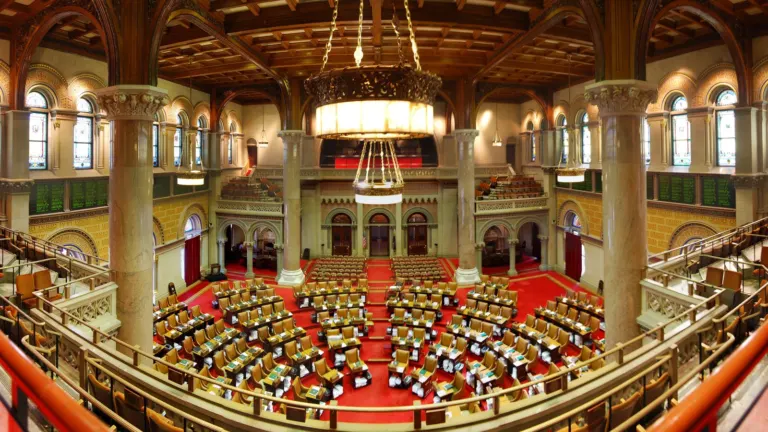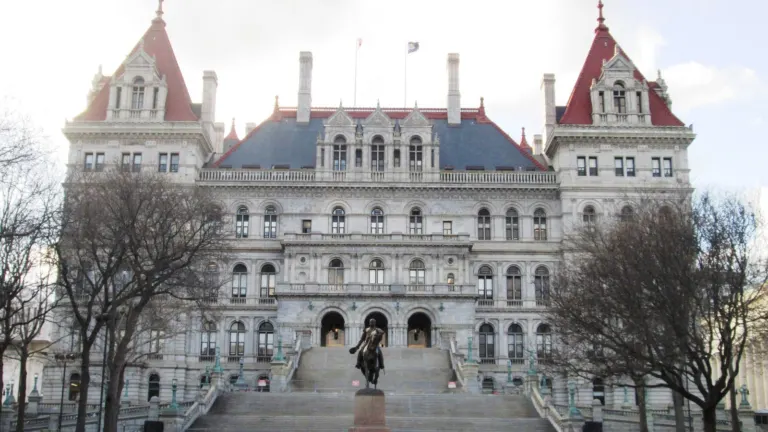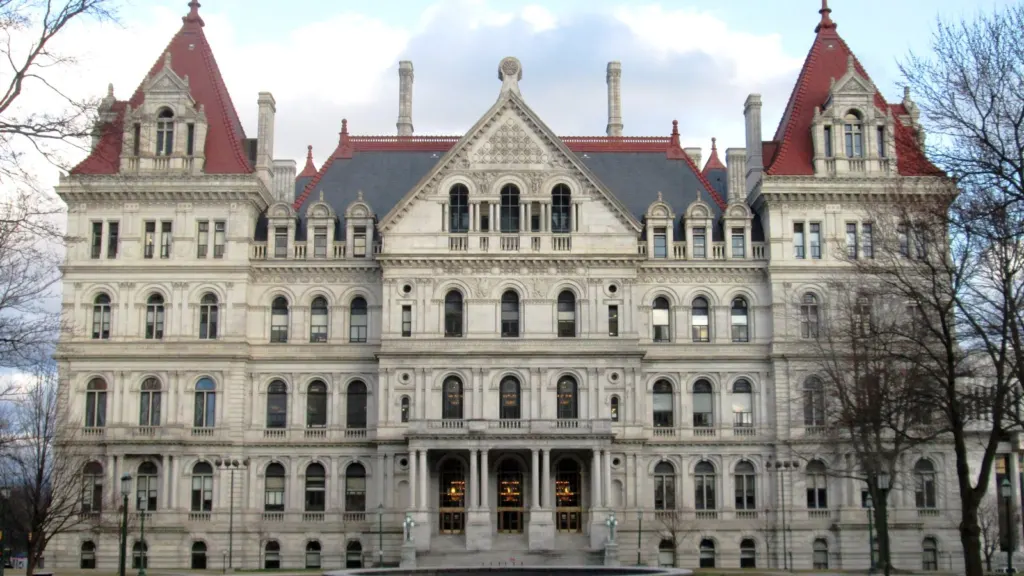
The New York State Capitol in Albany, where Democrats will return in January with veto-proof majorities in both houses, if the Nov. 10 seat counts hold. Photo: Beyond My Ken, CC BY-SA 4.0, via Wikimedia Commons.
Democrats will come back to the State Capitol in January with enough votes in both houses to override a gubernatorial veto, WXXI News reported on Nov. 10. As of that account, Democrats had won at least 111 of 150 Assembly seats, which WXXI described as the largest Assembly majority in history, and at least 47 of 63 Senate seats, the party’s largest Senate majority in more than a century. One Senate race in the Capital Region was still uncalled.
Those margins, if they hold, would give the conference the two-thirds majorities needed to override vetoes from Gov. Kathy Hochul. Assembly Speaker Carl Heastie and Senate Majority Leader Andrea Stewart-Cousins, in statements reacting to the election, said they were committed to using the majorities to improve the lives of New Yorkers, WXXI reported.
Sen. Shelley Mayer of Yonkers, who led the party’s Senate campaign effort, told the New York Public News Network that the new numbers would give the chamber more weight in budget talks, though she did not single out a particular issue. “I think our conference will flex its muscles in the budget negotiations,” she said. “The suburbs, the city of New York, the upstate cities, the rural communities, we got to care about it all.”
Some lawmakers and advocates are already pointing to long-sought items such as the New York Health Act, a single-payer health plan. Assemblymember Sarah Clark of Rochester told WXXI’s Connections the Legislature should raise taxes on the wealthy to help offset federal cuts. “We have to have the will to say you need to pay your fair share,” she said. WXXI noted that both houses added tax increases on the wealthy to their budget proposals this year, that Hochul resisted, and that lawmakers instead settled on a tax on second homes in New York City, which an appeals court allowed to move ahead last week after legal challenges.
Larry Levy, executive dean of the National Center for Suburban Studies at Hofstra University, cautioned that some of the seats that flipped from Republican to Democrat are in traditionally moderate areas, and that leadership would need to find issues that work in both the city and the suburbs. Assemblymember Josh Jensen, a Republican, said a minority party’s job is “to ask questions, demand accountability, and really make sure that important questions are being asked.” An early test, WXXI wrote, will come when Hochul releases her budget proposal and the Assembly and Senate follow with their own plans.
Add Observer Chronicle as a preferred source on Google (opens in a new tab)