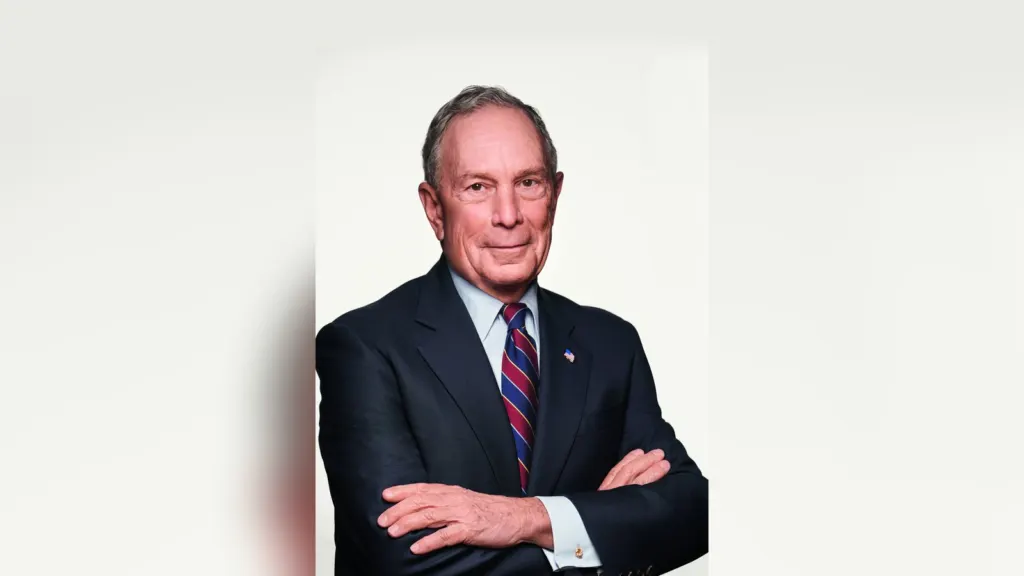
Michael Bloomberg as chair of the Defense Innovation Board in May 2018. Photo: Defense Innovation Board / Wikimedia Commons, Public domain
Michael Bloomberg built one of the world’s largest financial data companies, spent twelve years running New York City, and has since become one of the country’s biggest private donors. He remains a fixture in American business, politics and philanthropy.
From Medford to Wall Street
Bloomberg was born on Feb. 14, 1942, in Boston and grew up in Medford, Massachusetts. He earned a bachelor’s degree in electrical engineering from Johns Hopkins University in 1964 and an MBA from Harvard Business School in 1966.
He joined the investment bank Salomon Brothers that year and became a general partner in 1972. In 1981, Phibro bought the firm, and Bloomberg left. He then founded Innovative Market Systems, which was renamed Bloomberg L.P. in 1986. Its main product, the Bloomberg Terminal, gave traders and analysts a single screen for market data and analytics. News, radio and television operations followed as offshoots of that business.
Bloomberg served as chief executive from 1981 to 2001, stepped away to run for mayor, and returned to the job from 2014 to 2023.
Twelve years at City Hall
Bloomberg ran for mayor as a Republican in 2001 and took office on Jan. 1, 2002, as the 109th mayor of New York City. Voters re-elected him in 2005 and 2009, and he left office on Dec. 31, 2013, when Bill de Blasio succeeded him.
His administration led a rezoning of large parts of the city that opened the way for new commercial and residential construction after the Sept. 11 attacks. In 2003 he put in place a ban on smoking in indoor workplaces, including bars and restaurants.
A third term required a change in the law. On Oct. 23, 2008, the City Council voted 29-22 to extend term limits to three consecutive four-year terms, and Bloomberg signed the bill on Nov. 3. In November 2012, in the aftermath of Hurricane Sandy, he published an opinion column endorsing Barack Obama for president, citing Obama’s approach to climate change.
Presidential bid and philanthropy
Bloomberg launched a Democratic presidential campaign on Nov. 24, 2019. He financed it himself and spent more than $1 billion. He suspended the effort on March 4, 2020, after winning only American Samoa on Super Tuesday.
Giving has taken up much of his attention. He signed the Giving Pledge in August 2010, and Bloomberg Philanthropies directs its money toward public health, the arts, government innovation, the environment and education. The foundation donated or pledged $767 million in 2018 and more than $1 billion in 2019. Johns Hopkins, his alma mater, has been a regular partner, and its public health school carries his name.
Climate is a steady theme. In June 2019 he pledged $500 million to a campaign to close the nation’s remaining coal-fired power plants by 2030, and in September 2023 he committed another $500 million to the effort. In 2014 U.N. Secretary-General Ban Ki-moon appointed him the first Special Envoy for Cities and Climate Change. He later became the U.N.’s climate action envoy, resigned in November 2019, and was reappointed on Feb. 5, 2021, as Special Envoy on Climate Ambition and Solutions.
In 2024 he received the Presidential Medal of Freedom.
A national record, with no local tie
Bloomberg’s career has no documented link to Albany, Poughkeepsie or the river towns between them, so this profile stays on the national record. His influence runs through the company that carries his name, the foundation that spends his fortune, and a long record of political giving.
Details drawn from Wikipedia’s biography of Michael Bloomberg.