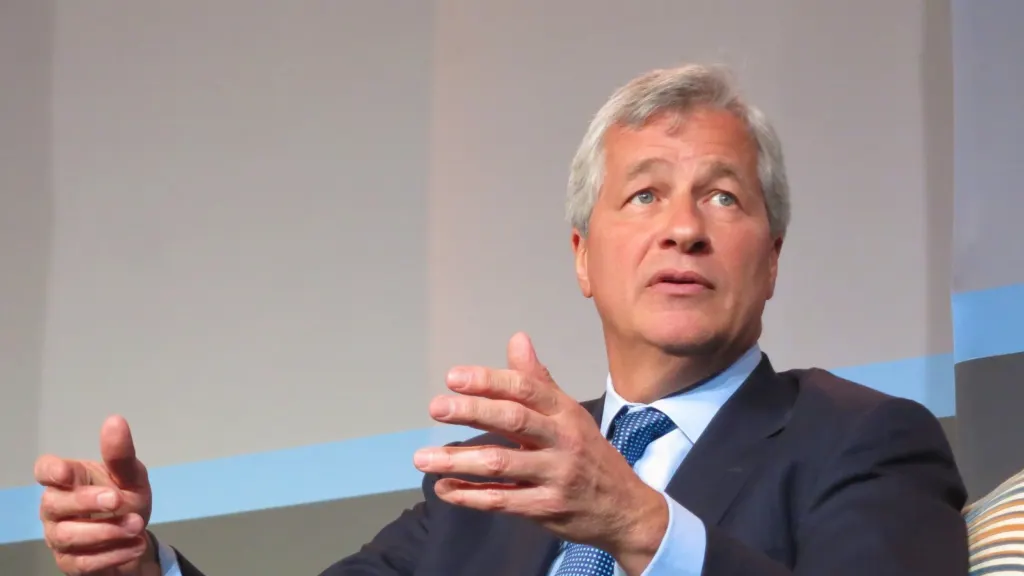
Jamie Dimon speaking at the JPMorgan Healthcare Investment Conference. Photo: Steve Jurvetson / Wikimedia Commons, CC BY 2.0
Jamie Dimon has run JPMorgan Chase since the last day of 2005, which makes him the longest-serving chief executive among the largest U.S. banks. He is also one of the few executives in the business whose public remarks on interest rates, regulation and the economy get covered as news in their own right. As of November 2025, he was 69 and still at the helm.
No verified connection ties Dimon to Albany, Poughkeepsie or the Hudson Valley. His story is a New York City one, and a national one.
From Queens to Tufts and Harvard
Dimon was born James Dimon on March 13, 1956, in New York City, and grew up in Jackson Heights, Queens. His family is of Greek ancestry. He has two brothers, Peter and a fraternal twin, Ted. He attended the Browning School in Manhattan, then Tufts University, where he graduated in 1978 with a bachelor’s degree in economics and psychology. He went on to Harvard Business School and earned an MBA in 1982 with Baker Scholar honors.
After Tufts he spent two years as a management consultant in Boston. In 1982 he joined American Express as an assistant to Sandy Weill, and the working relationship with Weill would shape the next 16 years of his career. When Weill moved to Commercial Credit in the mid-1980s, Dimon went with him and became chief financial officer at 30.
Travelers, Citigroup and Bank One
Through the 1990s Dimon served as chief operating officer of Travelers and of its Smith Barney brokerage unit. The 1998 merger that created Citigroup put him inside one of the largest financial companies in the world, but he left that November.
In March 2000 he became chief executive of Bank One. Four years later Bank One merged with JPMorgan Chase, and Dimon became the combined company’s president and chief operating officer. He was named chief executive on December 31, 2005, and a year later took on the additional titles of chairman and president.
Crisis, losses and illness
Dimon’s tenure has included several sharp tests. In December 2008, in the middle of the financial crisis, he called Alistair Darling, then Britain’s chancellor of the exchequer, to argue that a proposed 50% tax on bankers’ bonuses was too punitive.
In May 2012 the bank disclosed trading losses of at least $2 billion from a hedging strategy, an episode that became known as the “London Whale.” Dimon described the strategy as flawed and poorly executed and monitored. The Federal Reserve, the Securities and Exchange Commission and the FBI all looked into the matter. His pay was cut that year to $11.5 million, from $23 million in 2011, the highest among U.S. bank chiefs at the time.
Health problems have also been part of the public record. In 2014 Dimon was diagnosed with throat cancer and finished eight weeks of radiation and chemotherapy that September. In March 2020 he had emergency heart surgery to repair an acute aortic dissection. Gordon Smith and Daniel Pinto ran the bank during his recovery, and he returned to work remotely in April 2020.
Pay, wealth and succession
Compensation has risen in recent years. Dimon’s pay was reported at $34.5 million for 2022, $36 million for 2023 and $39 million for 2024. Most of his wealth comes from his JPMorgan stake, and he is counted among the few bank chief executives to become a billionaire.
Who will succeed him has been a standing question on Wall Street. In 2023 Dimon said he expected to stay about three and a half more years. In June 2025 he said his retirement was “several years away” and that he might remain longer than that.
He has been married to Judith Kent since 1983. They have three daughters: Julia, Laura and Kara Leigh.
Sources: Wikipedia, “Jamie Dimon.”