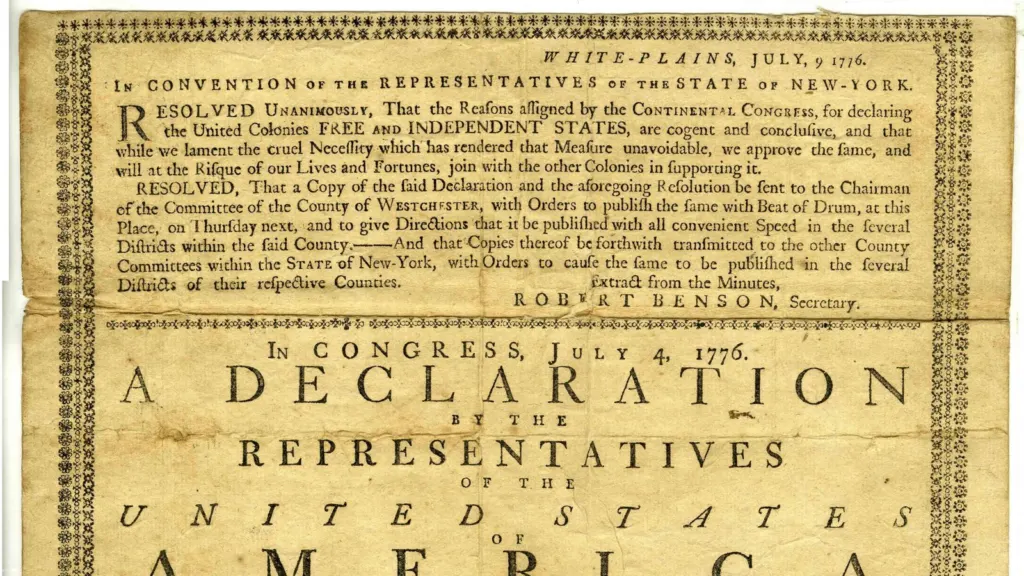
The top of a surviving John Holt broadside from July 9, 1776, held by the Cincinnati Museum Center. The copy on view at the Neuberger belongs to the Westchester County Archives. Photo: John Holt, publisher / Wikimedia Commons, public domain
New York did not sign on to independence on July 4, 1776. It took five more days. On July 9, meeting in White Plains, the state’s convention voted to back the Declaration and hired printer John Holt to put it on paper so it could be read aloud across the state. One of the few surviving sheets from that print run is on view at the Neuberger Museum of Art at SUNY Purchase, but only until Dec. 20.
The exhibition, “The Declaration Distributed: Westchester County’s Holt Broadside of 1776,” opened on July 4 in the museum’s Theater Gallery. The broadside belongs to the Westchester County Archives. Admission is free.
What the broadside says
Holt’s sheet is not just a reprint of the Declaration. Across the top, under the dateline “White-Plains, July 9, 1776,” it carries New York’s own resolution. The “Convention of the Representatives of the State of New-York” resolved unanimously that the reasons Congress gave for declaring independence were “cogent and conclusive.” The delegates said that while they lamented the “cruel Necessity” behind the step, they approved it and would join the other colonies in supporting it “at the Risque of our Lives and Fortunes.”
A second resolution ordered a copy sent to Westchester County’s committee chairman, to be published “with Beat of Drum” in White Plains the following Thursday. Copies were also to go to the other county committees, so the Declaration would be read out in every district. The text is signed by the convention’s secretary, Robert Benson. Only below that does the familiar heading begin: “In Congress, July 4, 1776. A Declaration by the Representatives of the United States of America.”
The museum points out in its exhibition notes that only 12 of the 13 colonies adopted the Declaration on July 4. New York was the holdout, and the broadside is the record of how it caught up.
The printer on the run
Holt (1721-1784) was a newspaper publisher whose patriot politics put him at odds with the British. New Rochelle city historian Barbara Davis told WAMC that he was chased from place to place and had to go to Kingston and to Connecticut. Printers, she said, were close to radicals at the time because they controlled how news got out.
According to the Neuberger, the exhibition traces the document, its printer, the role of printing during the Revolution and the first person in New York State to read it aloud, who lived on the land where SUNY Purchase now stands. It also follows where the sheet has been over the last 250 years and the work being done to preserve it. WAMC reported that the broadside sits in a climate-controlled case built by the National Institute of Standards and Technology.
A handful left
The museum calls Westchester’s copy “extremely rare, one of only a handful of sheets left from Holt’s print run.” The broadside measures about 20 by 12 inches. Another surviving copy, shown here, is held by the Cincinnati Museum Center. According to the description supplied with that copy, the others are at the Westchester County Archives, the New York Public Library and the Huntington Library in California.
For readers in the Capital Region, the exhibit pairs with a year of Revolutionary anniversaries closer to home, including the renamed Saratoga National Battlefield Park, which is getting ready for the 250th anniversary of the 1777 battles.
If you go
The Neuberger Museum of Art is at 735 Anderson Hill Road in Purchase, at the center of the SUNY Purchase campus. It is open Wednesday through Sunday from noon to 5 p.m. and is closed Monday and Tuesday. Admission is always free. The museum asks visitors to check its calendar before going, because some galleries close for installation. Groups of 10 or more need to reserve in advance.
The show closes Sunday, Dec. 20. More regional history and events are in our Hudson Valley section, including a look at DeWitt Clinton and the Erie Canal.
Add Observer Chronicle as a preferred source on Google (opens in a new tab)