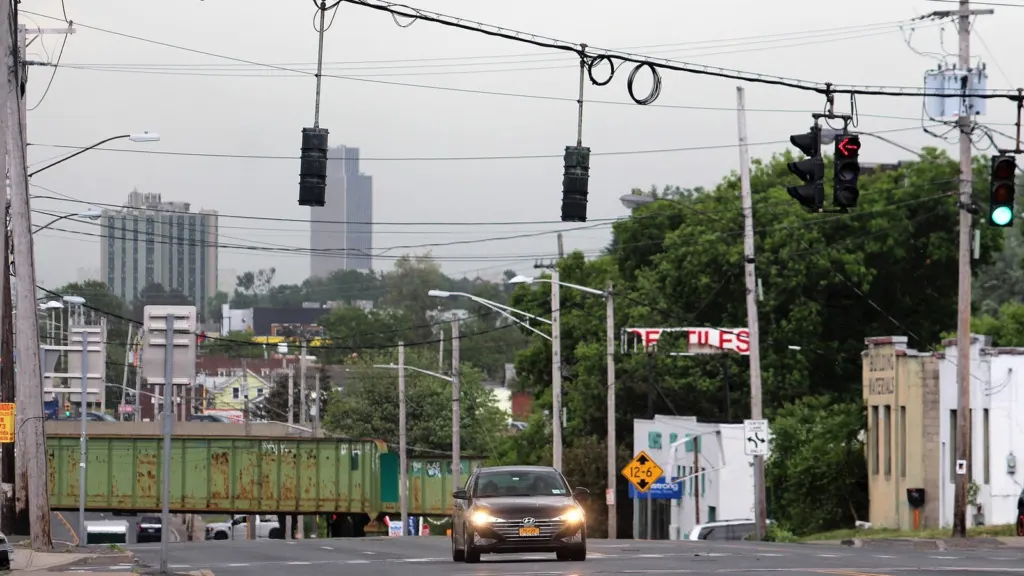
Central Avenue in Colonie, New York. Photo: Tyler A. McNeil, CC BY-SA 4.0, via Wikimedia Commons.
The Town of Colonie’s EMS department has won $4 million in federal money to expand emergency care across nine Capital Region counties, including a push to get blood to trauma patients before they reach a hospital.
The award comes through the U.S. Department of Transportation’s Safe Streets and Roads for All program. Colonie EMS announced it Nov. 10, and Rep. Paul Tonko, Sen. Chuck Schumer and Sen. Kirsten Gillibrand had announced the funding Oct. 30 as part of $8.18 million for three Capital Region projects. The new five-year effort is called the Capital Region Integrated Roadway Safety and Post-Crash Care Initiative.
What it pays for
It covers Albany, Columbia, Fulton, Greene, Montgomery, Rensselaer, Saratoga, Schenectady and Schoharie counties, which together have more than 1.1 million residents, according to Colonie EMS. The centerpiece is prehospital blood transfusion. With Albany Medical Center’s Blood Bank, its prehospital medicine division and the Regional Emergency Medical Organization, the project will test a coordinated regional blood program so trained paramedics can start treating severe blood loss in the field.
The grant also covers:
- Alerts that warn drivers an emergency vehicle is approaching.
- Better information sharing between dispatch centers and crews, and secure access to patient records.
- Community paramedicine programs for medically vulnerable residents.
- Analysis of crash data with regional transportation planners to find where roads put people at risk.
- Specialized training for participating EMS providers.
Building on an earlier grant
Deputy Chief Robbie MacCue developed the initiative. It builds on an earlier $2.4 million Safe Streets grant that Colonie shared with Guilderland EMS and Clifton Park-Halfmoon EMS, bringing the town’s federal roadway safety funding to $6.4 million. Dr. Michael Dailey, Colonie EMS’s medical director and director of Albany Medical Center’s prehospital medicine division, said the first grant “has already saved lives through our physician delivered blood program.” He said the new money will let EMS clinicians expand delivery and transfusion options as New York puts new blood regulations in place.
“EMS is essential infrastructure,” MacCue said in the release.
Sandra Misiewicz, executive director of the Capital Region Transportation Council, noted that national data show 40% of people who suffered fatal crash injuries were alive when first responders arrived. Post-crash care was one of the recommendations in the council’s regional Vision Zero safety action plan.
A second $4 million award nearby
Colonie will coordinate with a separate $4 million award to the Wilton Emergency Squad in Saratoga County, which Tonko’s office said focuses on similar work, including prehospital blood delivery. The third project in the package is $180,000 for the City of Hudson to write its first comprehensive safety action plan.
Colonie EMS, a town department since 1989, answers more than 15,000 911 calls a year and has about 100 paramedics and EMTs. The department said findings from the five-year project could become a model for EMS systems elsewhere in New York and beyond.
Add Observer Chronicle as a preferred source on Google (opens in a new tab)